
Semaglutide medications like Ozempic, Wegovy, and Rybelsus have become widely used, but their cost can be a challenge. Without insurance, monthly prices can reach several hundred dollars, putting them out of reach for many people.
Because of this, there’s growing interest in cheaper alternatives, including generic or off-brand versions. True generics are expected to match the original drug in how they work and how much of the medication is absorbed by the body.
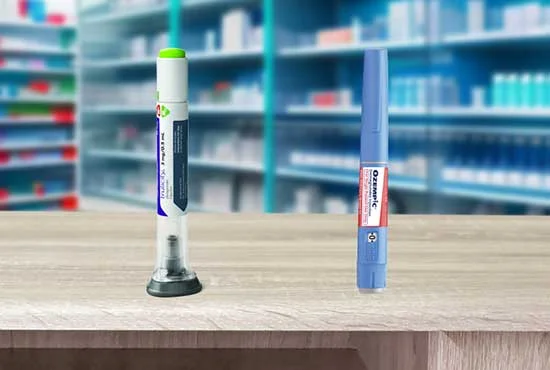
So, can a generic semaglutide be as effective as Ozempic? Let’s find out below!
What makes a drug generic?
According to the FDA, a generic drug is a medication created to be the same as an already marketed brand-name drug in dosage form, safety, strength, route of administration, quality, performance characteristics, and intended use. To ensure generics work the same as the brand, the FDA requires that:
Minor differences in inactive ingredients, such as fillers or preservatives, are allowed as long as they do not affect safety or effectiveness. The FDA notes that small variability in absorption occurs between batches of the same brand and between generics and brands, but these differences, around 3.5% in one study, are clinically acceptable.
For complex drugs like peptides, establishing bioequivalence can be challenging. The FDA has been working on research tools to evaluate complex generics and ensure they deliver the same amount of drug to the intended site at the same rate.
Manufacturers must demonstrate that their peptide is chemically identical to the brand’s active ingredient and behaves the same in the body. This complexity is one reason why there are still no fully approved generics for many injectable peptides.
Is generic semaglutide as effective as Ozempic?
Yes. The FDA’s Generic Drugs Program ensures that approved generic medicines meet the same high standards as their brand-name counterparts.
A generic must perform the same in the body as the brand, meaning it is the same in dosage form, route of administration, strength, and labeled use. It must also use the same active ingredient and deliver it into the bloodstream at the same rate and extent. FDA inspectors audit manufacturing plants and monitor safety reports after approval to ensure ongoing quality.
The FDA has also issued guidance on generic peptide development and establishing equivalence. If a generic manufacturer uses a different manufacturing method, minor differences in the amino acid sequence or impurities could affect the molecule’s behavior.
Novo Nordisk uses a yeast-based recombinant process, while generic makers may use solid-state peptide synthesis. The FDA requires detailed characterization of the active ingredient and comparative analytical and pharmacokinetic studies to ensure that any differences do not change safety or effectiveness.
Where can you get a generic version of Ozempic?
In the US, no FDA-approved generic version of Ozempic exists yet. Novo Nordisk’s patents covering semaglutide formulations and delivery devices remain in force, with some not set to expire until the early 2030s.
Canada has become the first G7 country to approve generic versions of semaglutide injection, with Health Canada authorizing two products to date.
The first Canadian approval, granted on April 28, 2026, was for a product submitted by Dr. Reddy’s Laboratories. A second approval followed on May 1, 2026, for a product submitted by Apotex. Both are generic versions of Ozempic indicated for once-weekly treatment of adults with type 2 diabetes to help manage blood sugar levels. Health Canada continues to review additional applications, with seven more submissions currently under evaluation.
How to buy generic semaglutide from Canada online

If you live in the US, you can have generic semaglutide shipped from Canada directly to your door. Here’s how:
Step 1. Search for “Generic semaglutide”
Use the search bar at the top of the website to search for “generic semaglutide.” Once you’re on the product page, select your prescribed dose (0.25 mg, 0.5 mg, or 1 mg) and click “Add to Cart.”
If you’d like to add additional medications, simply use the search bar to find them and add them to your cart. We carry a wide range of GLP-1 medications, including brand-name Ozempic, Wegovy, Mounjaro, and Zepbound. We also offer pen needles compatible with generic semaglutide pens.
Once you’ve added all of your medications and supplies, click the “Cart” button in the upper-right corner of the screen to proceed to checkout.
Step 2. Complete secure checkout
Once your cart is complete, proceed to checkout. Enter your contact details, payment information, and shipping address.
New customers will need to create an account using an email address and password. Remember to save 10% on your first order using coupon code FIRST10. Existing customers can log in with their current account details.
After submitting the order, you should receive a confirmation email.
Step 3. Upload, email, or fax your prescription
For prescription medications, we require a valid prescription before the order can be processed. You can send your prescription in one of three ways.
-
- Upload it directly on the website using the RX document uploader after placing your order.
- Email a clear scanned copy or photo of your prescription to info@buycanadianinsulin.com.
- Fax your prescription to 1-888-234-1275.
If your prescription is not on file when the team reviews your prescription order, BuyCanadianInsulin.com may contact you to request the required documentation.
Step 4. Wait for your generic Ozempic to arrive
Once a pharmacist reviews your order, eligible prescription orders can be processed for delivery. Tracking information is emailed when available so you can follow your shipment.

Is compounded semaglutide the same as generic semaglutide?
No.
During semaglutide shortages, many US compounding pharmacies began creating semaglutide injections from bulk active ingredients. Some telehealth companies marketed these products as “generic” or “off-brand” Ozempic. However, compounded semaglutide is not the same as a generic drug.
The differences include:
-
- Lack of FDA approval – Compounded drugs are not reviewed by the FDA. They do not undergo the same quality, safety, and effectiveness assessments as FDA-approved drugs. The FDA does not approve compounded semaglutide for any use.
-
- Customization – Compounded medications are custom-made to meet individual patient needs. While customization can be beneficial in certain situations (e.g., when a patient is allergic to an ingredient), compounding cannot legally produce exact copies of commercially available drugs when the approved product is available.
-
- Variable ingredients and formulations – Compounded semaglutide may contain different inactive ingredients or semaglutide salts, such as semaglutide acetate, instead of the semaglutide base used in Ozempic. These salt forms have not been tested for safety or efficacy. Some compounded products also mix semaglutide with vitamin B12 or other additives whose interactions are not well studied.
-
- Dosage forms and microdosing – FDA-approved semaglutide injections are dispensed in prefilled pens that deliver standardized doses (e.g., 0.25 mg, 0.5 mg, 1 mg, 2 mg for Ozempic). Compounded semaglutide is typically provided in a vial and drawn up with a syringe, increasing the risk of dosing errors. Some pharmacies also offer very low “microdoses,” but there is no evidence that such doses provide expected benefits.
While some patients have had positive experiences, others report inconsistent results. For example, a Reddit user who had lost 40 lbs with Ozempic described minimal weight loss after switching to compounded semaglutide despite using a higher dose.
Safety alerts on compounded semaglutide
When the FDA removed semaglutide from its shortage list in early 2025, it set deadlines for pharmacies to stop making exact copies by April 22 and for facilities by May 22. Despite these deadlines, compounded semaglutide has continued to circulate because enforcement is challenging and some compounding is allowed under limited circumstances.
The FDA has issued several warnings about compounded semaglutide. Reports have documented dosing errors with compounded semaglutide injections. Patients unfamiliar with drawing up medication from vials have inadvertently given themselves too much or too little medicine.
In another alert, the FDA noted that some compounded products contain salt forms of semaglutide (e.g., semaglutide sodium or acetate) that have not been tested for safety or efficacy. Novo Nordisk does not sell semaglutide for compounding, raising questions about where compounding pharmacies source their ingredients.
Manufacturing quality of compounded semaglutide
According to an analysis, imports of semaglutide powder from unapproved manufacturers, mostly in China, increased. There was a total of 268 kg of semaglutide imported into the US from March 2023 to September 2024. This is high, considering 1 g equals about 4,000 starting doses. FDA data show these shipments were initially detained at the border and later released.
Many of these suppliers have never been inspected by the FDA, and some that were inspected had quality-assurance violations. Among 11 firms with imported shipments, 20% of the volume came from firms never inspected, and 44.5% came from firms cited for Current Good Manufacturing Practice (CGMP) violations.
What to do if your generic or compounded semaglutide seems less effective
If you’re not seeing the results you expected from semaglutide, here’s what to check.
-
- Verify the product source – Make sure your medication comes from a licensed pharmacy. The FDA urges patients to check labels for accurate information and warns that fraudulent compounded semaglutide products have been found with fake pharmacy names. Ask your provider for the pharmacy’s license or accreditation.
-
- Check the formulation – Ask if the product contains semaglutide base (not salts) and whether it includes any additives. The FDA warns that salt forms like semaglutide acetate are untested and should not be used.
-
- Use the correct dose and injection technique – Dosing errors are common with vials and syringes. Use the syringe size recommended for your dose and be sure about the units you are measuring.
-
- Monitor your blood sugar and weight – If you have diabetes, keep a log of blood glucose readings. For weight management, track your weight and appetite changes. If results are not as expected after several weeks, consult your healthcare provider to discuss whether the dose, formulation, or medication should be changed.
-
- Report problems – If you experience adverse effects or suspect that the product is counterfeit, report it through the FDA’s MedWatch program. Reporting helps regulators identify problems and protect other consumers.
-
- Avoid unverified online suppliers – Never buy semaglutide from social media sellers, gym contacts, or websites that don’t ask for a prescription. The FDA notes that illegal products may be counterfeit and unsafe.
Bottom line
True generics are required to be bioequivalent to Ozempic, meaning they are expected to deliver the same clinical effect for blood sugar management and weight loss. While there is still no FDA-approved generic semaglutide available in the United States, Canada has already approved generic versions that you can purchase today for $184.
Compounded semaglutide is not the same as a true generic. Compounded products can vary in formulation, quality, and oversight, and they do not undergo the same approval process required for generic medications. If you’re looking for a lower-cost alternative to Ozempic, approved generic semaglutide from Canada offers a more regulated and reliable option.
Frequently Asked Questions
Articles you may also be interested in


Sources
FDA. (2021, March 16). Generic drugs: questions & answers. U.S. Food And Drug Administration. https://www.fda.gov/drugs/frequently-asked-questions-popular-topics/generic-drugs-questions-answers
Davit, B. M., Nwakama, P. E., Buehler, G. J., Conner, D. P., Haidar, S. H., Patel, D. T., Yang, Y., Yu, L. X., & Woodcock, J. (2009). Comparing Generic and Innovator Drugs: A Review of 12 Years of Bioequivalence Data from the United States Food and Drug Administration. Annals of Pharmacotherapy, 43(10), 1583–1597. https://doi.org/10.1345/aph.1m141
Health Canada. (2026, May 1). Canada approves second generic semaglutide, the first G7 country to do so. Canada.ca. https://www.canada.ca/en/health-canada/news/2026/05/canada-approves-second-generic-semaglutide-the-first-g7-country-to-do-so.html
Health Canada. (2026, April 28). Canada becomes the first G7 country to approve a generic version of semaglutide. Canada.ca. https://www.canada.ca/en/health-canada/news/2026/04/canada-becomes-the-first-g7-country-to-approve-a-generic-version-of-semaglutide.html
Apotex Receives First U.S. FDA Tentative Approval for a Generic Version of Ozempic® (Semaglutide Injection) in Partnership with Orbicular. (2026, April 10). https://www.apotex.com/global/news/news-release/2026/04/10/apotex-receives-first-us-fda-tentative-approval-for-a-generic-version-of-ozempic-semaglutide-injection-in-partnership-with-orbicular
FDA. (2024, July 26). FDA alerts health care providers, compounders and patients of dosing errors associated with compounded injectable semaglutide products. U.S. Food And Drug Administration. https://www.fda.gov/drugs/human-drug-compounding/fda-alerts-health-care-providers-compounders-and-patients-dosing-errors-associated-compounded
Wosi?ska, M. E. (2025, April 21). The Wild East of semaglutide. Brookings. https://www.brookings.edu/articles/the-wild-east-of-semaglutide/
Office of the Commissioner. (2026, April 30). MedWatch: The FDA Safety Information and Adverse Event Reporting program. U.S. Food And Drug Administration. https://www.fda.gov/safety/medwatch-fda-safety-information-and-adverse-event-reporting-program
FDA. (2019, February 5). Impact Story: Overcoming Challenges to Evaluating bioequivalence in complex drugs. U.S. Food And Drug Administration. https://www.fda.gov/drugs/science-and-research-drugs/impact-story-overcoming-challenges-evaluating-bioequivalence-complex-drugs


